7 Module 5: Effective Interdisciplinary Teams (40 minutes)
Facilitator: Colleen Cuddy, Salutogenesis (AI-READI)
7.1 Learning Objectives
By the end of this module, participants will be able to:
- Distinguish between surface-level and deep-level heterogeneity in team composition, and explain why both matter.
- Place a research team on the monodisciplinary–transdisciplinary continuum and identify the coordination demands that follow from that position.
- Apply Thompson’s interdependence framework to identify the appropriate coordination mechanism for a team’s work structure.
- Assess a team against Hackman’s 5 structural conditions and Edmondson’s dynamic principles, and identify at least one concrete improvement.
7.2 Module Overview
Assembling a team with diverse expertise does not automatically produce better science. Research consistently shows that diverse teams outperform homogeneous teams on complex problems — but only when they are structured and led in ways that allow that diversity to be expressed. A team that brings together a genomicist, a statistician, a clinician, and an ethicist has the ingredients for innovation; whether those ingredients combine productively depends on processes and culture that most teams never explicitly design.
This module provides two interlocking frameworks for understanding and improving interdisciplinary team effectiveness. Thompson’s interdependence framework helps teams understand what kind of coordination their work actually requires — because a team doing sequential work (where outputs flow from person to person) needs very different processes than a team doing reciprocal work (where everyone’s output is constantly feeding everyone else’s). Hackman’s structural conditions and Edmondson’s dynamic principles then provide a diagnostic: five structural requirements and three behavioral conditions that distinguish teams that succeed from teams that struggle. Together, these frameworks give participants a language for diagnosing what is going wrong — and a set of evidence-based levers to pull.
7.3 Participant Background Reading
Participants are encouraged to review the following before the session. Each takes 15–25 minutes.
Page, S. E. (2007). The Difference: How the Power of Diversity Creates Better Groups, Firms, Schools, and Societies. Princeton University Press. The empirical and theoretical case that diverse problem-solving groups outperform homogeneous ones on complex tasks. Read the Introduction or Chapter 1 for the core argument. This grounds the “Why this matters” evidence in the content block.
Edmondson, A. C. (1999). “Psychological Safety and Learning Behavior in Work Teams.” Administrative Science Quarterly, 44(2), 350–383. The foundational paper establishing that psychological safety — not just team composition or structure — determines whether teams learn and perform. Read the abstract, introduction, and the discussion sections. Focus on: what is psychological safety, how is it created, and what happens when it is absent.
A short accessible explanation of what “transdisciplinary” means in practice. Many participants conflate multidisciplinary, interdisciplinary, and transdisciplinary. Before the session, find and read a short piece that distinguishes these clearly with examples (search “multidisciplinary vs interdisciplinary vs transdisciplinary” for accessible explainers). The goal is to arrive with a working definition of each term so the continuum diagram makes immediate sense.
7.4 Instructor Notes
7.4.1 Conceptual Background
Why diversity needs inclusion. The key insight from Nishii (2013) — that multidisciplinarity can hurt as well as help — is often surprising to participants. The mechanism is important: diversity increases the range of perspectives available, but it also increases the likelihood of miscommunication, misaligned assumptions, and social exclusion. Whether the benefits outweigh the costs depends on inclusion climate: whether the team has norms, practices, and leadership behaviors that actively draw out diverse contributions. Without inclusion, diversity often fragments into competing silos.
Thompson’s framework in practice. The three interdependence types map cleanly onto research team structures: - Pooled interdependence is common in core facilities or data collection networks, where each site collects data independently according to a shared protocol. Coordination is primarily about standardization — common data dictionaries, shared SOPs, consistent formats. - Sequential interdependence appears in pipeline-style projects: a data collection team feeds a processing team feeds an analysis team. Coordination is about handoff quality and timing — are data delivered in the right format, at the right time? - Reciprocal interdependence characterizes truly integrative interdisciplinary work — for example, when a clinician’s interpretation of a finding changes the statistician’s model, which changes the ethicist’s framing of consent, which changes the clinician’s protocol. This is the most cognitively demanding form and requires the most intensive communication infrastructure.
A useful facilitation move: ask participants to identify which type of interdependence actually characterizes their team’s work — and then ask whether their current coordination mechanisms match. Teams often discover they are using standardization-level coordination (forms, procedures) for what is actually reciprocally interdependent work.
Hackman’s 5 conditions. J. Richard Hackman’s research on team effectiveness identified five conditions that are necessary (though not sufficient) for teams to perform well. Instructors should know that Hackman was studying teams across many contexts — not just research teams — and that his findings are robustly replicated. The condition most often violated in research teams is Compelling Direction: many research teams have a general topic but not a clear, shared, and consequential purpose that members can articulate and that guides decisions.
Edmondson’s psychological safety. Amy Edmondson’s concept of psychological safety is widely cited but often misunderstood. It is not about being nice or comfortable. It is specifically about whether people believe they can speak up — with ideas, questions, concerns, or mistakes — without being punished or humiliated. Research teams with low psychological safety see junior members staying silent when they notice problems, people avoiding questions that might reveal ignorance, and conflict being suppressed until it explodes. Facilitators should be prepared to distinguish psychological safety from general likeability or team cohesion.
Facilitating Activity 5.b. The pair discussion is designed to be low-stakes: participants share rankings with one neighbor, not the full group. This makes honest assessment more likely. Encourage participants to be specific: “I ranked Enabling Structure low because we’ve never talked about our norms” is more useful than “I ranked it 2.” If time allows, bring 2–3 specific observations to the full group debrief rather than asking everyone to share.
7.4.2 Key Concepts
- Surface-level heterogeneity: Diversity on characteristics that are visible or readily known — demographics, disciplinary background, institutional affiliation, career stage.
- Deep-level heterogeneity: Diversity on characteristics that emerge through interaction — thinking styles, work preferences, communication styles, risk tolerance, tacit knowledge.
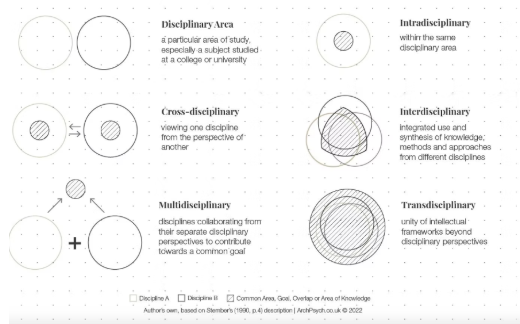
- Monodisciplinary / Multidisciplinary / Interdisciplinary / Transdisciplinary: A continuum describing how deeply multiple disciplines integrate their work. Multidisciplinary teams work in parallel from their own perspectives; interdisciplinary teams integrate approaches to create synthesized knowledge; transdisciplinary teams transcend disciplinary boundaries to create new shared conceptual frameworks.
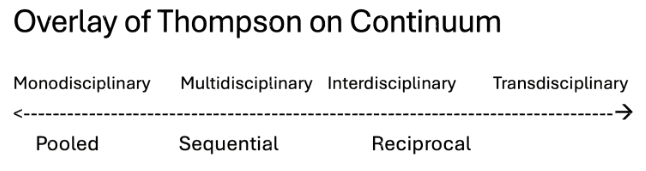
- Pooled interdependence: A work structure where members contribute independently to a common goal. Coordination via standardization.
- Sequential interdependence: A work structure where one person’s output becomes the next person’s input. Coordination via planning and scheduling.
- Reciprocal interdependence: A work structure where outputs flow back and forth between members iteratively. Coordination via mutual adjustment (constant communication and feedback).
- Hackman’s 5 conditions: Real Team, Compelling Direction, Enabling Structure, Supportive Context, Expert Coaching — the structural prerequisites for team effectiveness.
- Psychological safety: The shared belief that the team is safe for interpersonal risk-taking — specifically, that speaking up with ideas, questions, concerns, or mistakes will not result in punishment or humiliation.
- Inclusion climate: The extent to which a team’s norms and practices actively draw out and value diverse contributions, rather than defaulting to dominant voices or perspectives.
7.4.3 Recommended Instructor Reading
- Thompson, J. D. (1967). Organizations in Action. McGraw-Hill. The original source of the interdependence typology — chapters 1–3 are most relevant. Instructors who want to understand the framework at a deeper level should read directly rather than relying on summaries.
- Hackman, J. R. (2002). Leading Teams: Setting the Stage for Great Performances. Harvard Business School Press. The accessible version of Hackman’s research; chapters 2–4 cover the 5 conditions.
- Nishii, L. H. (2013). “The Benefits of Climate for Inclusion for Gender-Diverse Groups.” Academy of Management Journal, 56(6), 1754–1774. The empirical paper showing that diversity benefits depend on inclusion climate.
- Woolley, A. W., Chabris, C. F., Pentland, A., Hashmi, N., & Malone, T. W. (2010). “Evidence for a Collective Intelligence Factor in the Performance of Human Groups.” Science, 330(6004), 686–688. Shows that collective intelligence (the ability of groups to perform well across tasks) is predicted by the proportion of women in the group, social sensitivity of members, and equal turn-taking — all components of inclusion.
7.5 Content Block: The Foundation for Effective Interdisciplinary Teams (10 minutes)
7.5.1 Why this matters:
Complex scientific problems demand diverse perspectives
Multidisciplinary teams outperform homogeneous teams on complex problems (Page, 2007)
Multidisciplinarity alone isn’t enough - inclusion practices determine whether engaging a broader scope of disciplines helps or hurts (Nishii, 2013)
Small changes in process can have big impacts on who participates and how (Woolley, 2010)
7.5.2 Understanding Different Types of Team Composition
7.5.2.1 Levels of Heterogeneity
Surface-Level Heterogeneity:
- Demographics: gender, race, age, nationality
- Disciplinary backgrounds
- Institutional affiliations
- Career stages
Deep-Level Heterogeneity:
- Thinking styles (analytical vs. intuitive)
- Work preferences (individual vs. collaborative)
- Communication styles (direct vs. indirect)
- Risk tolerance (conservative vs. experimental)
- Skillsets (technical vs interpersonal)
7.5.3 Continuum of monodisciplinary to transdisciplinary
- Monodisciplinary: Working within a single field.
- Interdisciplinary: Multiple disciplines work together, integrating their approaches to create new, synthesized knowledge.
- Multidisciplinary: Multiple disciplines work in parallel from their own perspectives.
- Transdisciplinary: Transcends disciplinary boundaries to create a new, shared conceptual framework.
7.5.4 Thompson’s Interdependence & Coordination
Thompson (1967) provides a framework for the coordination of work based on levels of interdependence.
| Types of Interdependence | Key Coordination Method | ||
|---|---|---|---|
| Pooled | Team members work independently and contribute their separate pieces to a common goal. The output is the sum of their efforts. | Standardization | Relies on establishing common rules, procedures, and standards that all members follow. This ensures outputs are consistent and can be easily aggregated with minimal interaction |
| Sequential | The work flows in an assembly-line fashion. One person’s or group’s output becomes the input for the next person or group. | Planning & Scheduling | Focuses on creating schedules and timelines to manage the flow of work between stages. The goal is to ensure smooth and timely hand-offs from one member to the next. |
| Reciprocal | Work is iterative and requires back-and-forth interaction. Each members output is an input for others, and vice-versa, in a dynamic process. | Mutual Adjustment | Requires constant communication. feedback, and shared decision-making. Team members continuously adapt their actions in response to others. This is the most intensive and demanding form of coordination. |
The further you move along the continuum, the more significant coordination becomes.
7.5.5 Activity 5.a: Individual Reflection: (5 Minutes)
Take a moment to think. How deep is your heterogeneity? Does your team have the diversity required to match the complexity of the work? Where does your primary research team currently fall on this continuum? Where would you like it to be? Where does it need to be?
7.6 Content Block: What makes a good interdisciplinary team? Structure and Dynamics (10 minutes)
Two key frameworks help us create the conditions for success: one for the team’s structure and one for its dynamics.
The Structural Foundation (J. Richard Hackman’s 5 Conditions)
Real Team: Clearly bounded, stable membership.
Compelling Direction: A clear, challenging, and consequential purpose.
Enabling Structure: The right mix of people and clear norms of conduct.
Supportive Context: Access to resources, information, and rewards for teamwork.
Expert Coaching: Help with the process and removing roadblocks.
Team Dynamics (Amy Edmondson’s Principles)
Psychological Safety: A shared belief that the team is safe for interpersonal risk-taking. People feel comfortable speaking up with ideas, questions, or mistakes.
Inclusive Leadership: Leaders who actively invite and appreciate contributions from everyone.
Deliberate Processes & Practices: Intentionally designing how the team communicates, makes decisions, and resolves conflict.
7.7 Activity 5.b: Team Assessment & Discussion (13 minutes)
- Take a couple of minutes to reflect on your team and rank it based on Hackman and Edmonson’s Frameworks.
- Share your ranking with your neighbor, take turns, and discuss the following:
- Why did you choose these rankings?
- What are some things the team is doing well?
- Where is there an area for growth?
- What are some practices and processes that you might introduce?
Module Materials